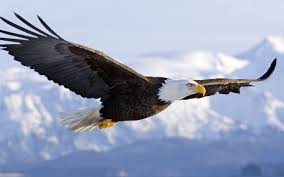
 About two miles north of my house live a pair of bald eagles, and, like a good neighbor, I will occasionally wave when I see them fly by. Well, not really, but I always take a few moments acknowledge and watch them. When I came home the other day one was soaring right over my house.
This was an awesome sight; watching the eagle rise
high with the thermals, make a wide, lazy spiral, and then shoot off in a line towards the setting sun.
It made me think about the ease with which they fly.
Eagles have very long, large wings. The size of these wings allow them to fly powerfully, carrying their own bodyweight as well as any prey that they catch.
The downside of having such a large wings is that it takes a lot of energy to continually flap them. To compensate for this, eagles spend much of their time in the air floating and soaring. In fact, an eagle can spend as little as two minutes per hour flapping its wings in flight. They have adapted perfectly to the tools they have. Nature is wonderful like that; almost every creature has a story about adapting to its own reality.
Soaring High
As I stood and watched the eagle streak off to the west without once flapping its wings, I started to compare the way they fly, in a general sense, to what is possible for us after we have experienced a brain injury.
Each of us surfaces from a brain injury with circumstances that are wildly different from one another, but we all have this one thing in common: we face the challenge of adapting to a world which has become very different from what we knew. We are forced to evolve and adapt by finding a way to use the tools we were given.
The eagle, through evolution, has figured out how to live its life the best way it can with the tools it has, much as we need to do. It has found a way to travel without flapping its oversized wings and burning excessive energy.
One big difference between us and eagles, as well as all the other creatures in nature, is that animals have evolved over thousands of years, while we need to evolve quickly after experiencing a TBI; when our life changes in instant. It is a challenge we need to accept.
We all have that iconic picture of the bald eagle etched in our minds; its grace and beauty as it soars high above. With the wind at its back, it glides smoothly and effortlessly across the horizon.
The wind at our back
What struck me the most from watching the eagle was the symbolism of having the wind at it’s back as it moved to the west. We all equate having the wind at our back with ease of travel.
Isn’t that what we all want, “the wind at our back”; a gentle push, spurring us forward as we meet all of our challenges?
Our road feels so hard, with the rewards few and far between. Having the wind at our back would make things easier and give us a respite, even if only for a few minutes. Having the wind at our back would make make us feel not so alone as we face our battles.
We would like for things not to be such a challenge, and for life to cooperate. Having the “wind at our back” would be a big help, but how do we go about getting the wind at our back?
How can we adapt to our situations, using the tools we have to make life easier and create a situation where the “wind it is at our back?”
I guess the first thing we need to do is accept our TBI as a reality in our life. This doesn’t mean it is something we give in to, but it does mean we are going to have to make allowances and use our heads so we can learn how to move forward.
We have not lost the ability to think and use our heads. Although we have had a “brain injury”, our brain remans a powerful tool we human beings are blessed with. However, we need to accept our power and develop our confidence in order to use it.
We all have the ability to think and to reason. We should use these tools t0 work to make our life easier by figuring out a way to get the wind at our backs. It will be different for all of us, based on our situations and our abilities.
Having the “wind at our backs” means doing things so they are easier, not more difficult.
This starts with our mental state: our belief in ourselves and our confidence. We need to understand we are more in control of our own lives than we might think, and we have the power to impact our lives positively. That would be s great start. Then, rather than “fighting” our brain injuries, let’s work to find smarter and more productive ways to adapt to them so we can learn to really soar.
Thanks, Jeff

Something that has been on my mind a lot lately is I love my brain. It’s a good one, with many gifts I’d always taken for granted, and many gifts yet unfolded. Now, after a rough time following a concussion/TBI, I value it so much more. The brain I/you have is an awesome creation with amazing abilities to heal and rewire as needed! Seeing your brain as a blessing for what it is, is priceless. Great article on soaring, I too now watch all sorts of animals and marvel at how we’re all unaware of our brains until, suddenly, we’re aware…
Thank you for the wonderful imagery. I am told i have memory issues, but my friend and family day I have the wonderful ability to forget as well as the wonderful ability to hold onto those memories I want to remember. That had to be a learned skill, one that is very helpful. Select what you want and forget the rest. My friend tell me I have the memory of an elephant, gently kind and compassionate. Why not?
Thank you sooooo much for your kind, encouraging words! I’m thankful to have met you and to have signed up for your wonderful writings!
Beautiful. Moving. Thought provoking.
Thank you so very much.
I needed to hear those words today.
I, too, have bald eagles near my home.
They never cease to inspire me.
Today even the chickadee bearing the freezing temperatures and wind at my feeder reminded me of the power of natures most fragile creatures.
We have the power and strength to move forward…..and upward with the wind behind us and beneath our wings!
Thank you for reminding me……..
Very insightful! Thank-you! In my work with TBI survivors, I find that the greatest obstacle ro moving forward is the fight against acceptance. Our motto is: freedom to try and courage to soar…..your blog so importantly points out that these can both be achieved.
Thank You !!! Everything you said is so true, and Thought provoking !!!